The Solar Wind Effect: How Sun Activity Accelerates Space Junk Reentry – A Hands-On Guide
Overview
Every day, thousands of pieces of space debris circle Earth, from spent rocket stages to shattered satellite fragments. For decades, scientists have tried to predict when and where this junk will fall back to Earth. A landmark 36-year study has revealed a surprising accelerator: the Sun. When solar activity rises, it heats and expands Earth's upper atmosphere, increasing drag on orbital objects and pushing them down faster. This guide unpacks the physics behind this phenomenon, shows you how to model the decay process using real data, and helps you avoid common pitfalls when analyzing orbital lifetimes.
Prerequisites
Before diving into the mechanics of solar-driven orbital decay, make sure you have:
- Basic orbital mechanics knowledge: Understand concepts like semi-major axis, eccentricity, and apogee/perigee.
- Fundamental physics background: Familiarity with drag force (F_d = ½ ρ v² C_d A) and ideal gas laws.
- Access to data sources: Recommended: NASA's Two-Line Element (TLE) sets via CelesTrak, and solar activity indices (F10.7 cm flux) from NOAA's SWPC.
- Computing environment: Python with
numpy,matplotlib, andskyfieldlibraries installed. A Jupyter notebook works best.
Step-by-Step Instructions
1. Understand the Physics – Solar Activity & Atmospheric Drag
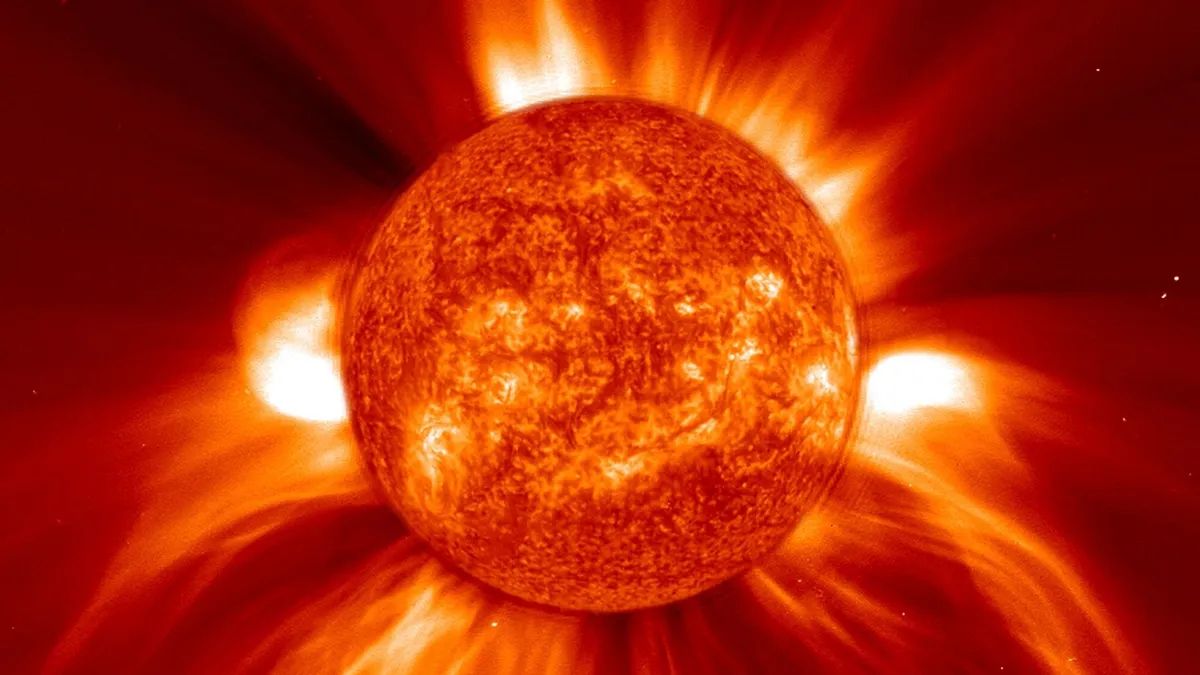
The key driver is the thermosphere, the uppermost layer of Earth's atmosphere (80–700 km altitude). When the Sun is active – more sunspots, flares, coronal mass ejections – it emits extreme ultraviolet (EUV) and X-ray radiation. This energy heats the thermosphere, causing it to expand outward. Higher solar activity means higher atmospheric density at any given orbit altitude. Since drag force scales with density, space junk experiences greater deceleration during solar maxima.
Example: At 400 km altitude, the density can vary by a factor of 10 between solar minimum and maximum. A satellite in a circular orbit at 400 km might have its lifetime shortened from decades to just a few years during a solar max.
2. Gather Real Data – TLEs & Solar Indices
To replicate the 36-year study, you need two data streams:
- Space debris orbital data: Download TLEs for a specific piece of debris (e.g., the defunct satellite Cosmos 2251) from CelesTrak's archive. The study covered 1985–2021.
- Solar activity data: Obtain the daily F10.7 cm solar flux (in sfu, solar flux units). This is a proxy for EUV radiation and is available from NOAA's Space Weather Prediction Center.
Code snippet 1 – Fetching F10.7 data using Python:
import urllib.request
import csv

url = 'https://services.swpc.noaa.gov/json/solar_flux/10.7_cm_flux.json'
response = urllib.request.urlopen(url)
data = json.loads(response.read())
# Extract date and flux value
dates = [entry['time_tag'] for entry in data]
flux = [entry['flux'] for entry in data]
3. Compute Orbital Decay Rate
The decay rate of a satellite's semi-major axis a due to drag can be approximated by:
da/dt = – (C_d A / m) n ρ a² / (1 – e²)√(a/μ) · (1 + 2 e cos ν + e²)3/2
Where:
• C_d = drag coefficient (~2.2)
• A = cross-sectional area (m²)
• m = mass (kg)
• n = mean motion
• ρ = atmospheric density (kg/m³) at the satellite's altitude
• e = eccentricity
• ν = true anomaly
• μ = Earth's gravitational parameter
For simplicity, we average over an orbit using the Jacchia-Bowman 2008 (JB2008) atmospheric model, which takes F10.7 as input. Use the poliastro library in Python:
from poliastro.earth import EarthSatellite
from poliastro.earth.atmosphere import jacchia_bowman_2008

# Define orbit from TLE
sat = EarthSatellite.from_tle('CUNNINGHAM', tle_lines)

# Compute decay at a given epoch
atmos = jacchia_bowman_2008(sat.orbit, F10_7=150.0, Ap=15.0)
da_dt = sat.decay_rate(atmosphere=atmos)
4. Simulate Over 36 Years
Loop over all TLE epochs and the corresponding F10.7 values. For each time step, update the semi-major axis by integrating the decay rate. The study found that during solar maxima (years 1990–1992, 2000–2003, 2012–2014), the decay accelerated by 2–3 times compared to solar minima.
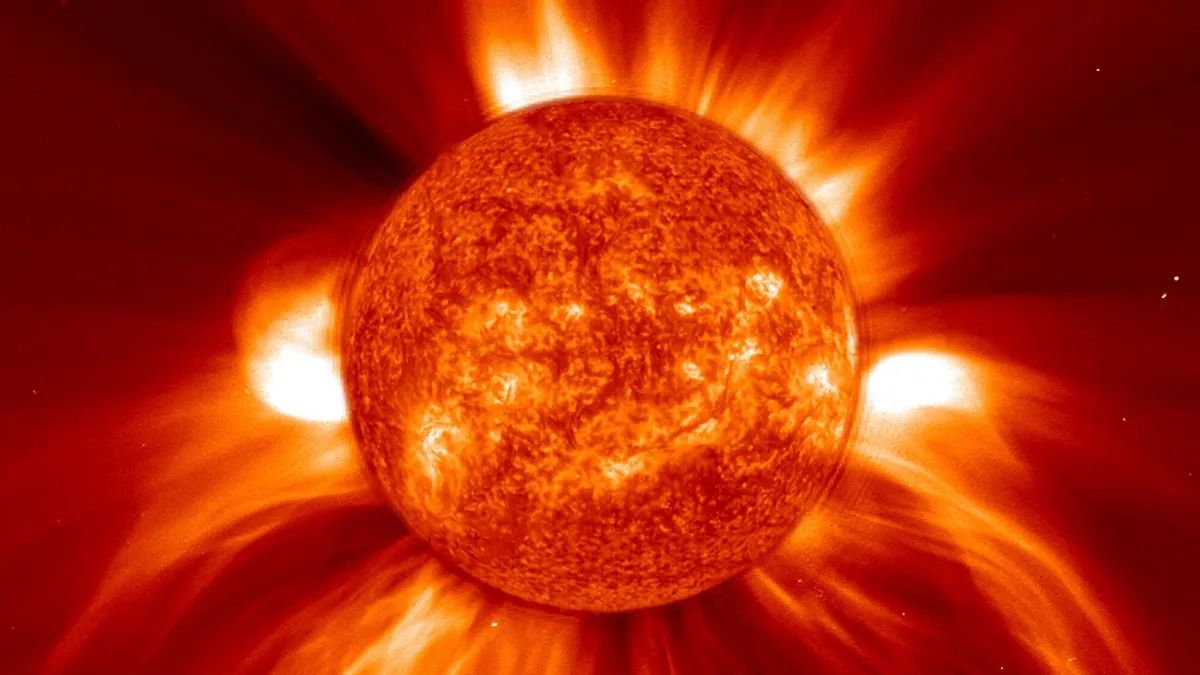
Key observation: The altitude of the space junk drops faster when the Sun is active. For example, a piece of debris starting at 800 km altitude might take 30 years to reenter at solar minimum but only 8 years at solar maximum.
5. Visualize the Correlation
Create a scatter plot of da/dt vs. F10.7 flux. You should see a positive linear trend – higher flux leads to faster decay. The 36-year study also separated the data by altitude bands:
- 300–500 km: Strong correlation (R² > 0.8)
- 500–700 km: Moderate correlation (R² ~0.6)
- Above 700 km: Weaker but still significant
Code snippet 2 – Plotting:
import matplotlib.pyplot as plt
plt.scatter(flux_values, decay_rates, alpha=0.5)
plt.xlabel('F10.7 cm solar flux (sfu)')
plt.ylabel('da/dt (km/day)')
plt.title('Solar Activity vs. Orbital Decay of Cosmos 2251')
plt.show()
Common Mistakes
Ignoring the Time Lag
Solar EUV radiation doesn't heat the thermosphere instantly – there's a lag of 1–3 days. When you compare daily decay rates with daily F10.7, you may see no correlation. Always use a moving average or shift the solar data by 1–2 days.
Using a Static Atmospheric Model
Many default models assume a constant density or a simple altitude profile. The JB2008 model is the minimum recommended. The 36-year study used the NRLMSISE-00 model driven by real-time F10.7 and geomagnetic Ap indices.
Neglecting Solar Cycle Phase
Solar cycles last about 11 years, but the rise and fall are asymmetric. Maximum occurs quickly; minimum lingers. If you only analyze a few years, you may misinterpret the trend. The study's strength was its full 2.5-cycle coverage.
Forgetting Ballistic Coefficient Variability
The ratio m/(C_d A) (ballistic coefficient) changes as debris tumbles and sheds mass. A tumbling rocket body will have a different average cross-section over time. For precise lifetime predictions, use attitude propagation.
Summary
Solar activity is a powerful, predictable driver of space junk reentry. By combining orbital TLE data with solar flux measurements and a realistic atmospheric model, you can quantify how the Sun's eleven-year heartbeat dictates the lifespan of debris. The 36-year study confirmed that during periods of high solar activity, debris decays up to three times faster than during quiet Sun. This knowledge is crucial for mission planning, collision avoidance, and de-orbiting strategies. With the tools and steps outlined above, you can now replicate the analysis, avoid common pitfalls, and even forecast the fate of your own satellite or piece of space junk.