Mastering Python Deque: The High-Performance Secret for Sliding Windows and Streams
In many Python applications, processing real-time data streams or maintaining sliding windows often leads developers to use lists. However, lists can be inefficient due to O(n) shift operations. Enter collections.deque (double-ended queue) – a specialized container that provides O(1) appends and pops from both ends. This article answers your burning questions about how deque revolutionizes sliding windows, thread-safe queues, and efficient data handling.
What Exactly Is a Sliding Window Problem and Why Does It Matter in Python?
A sliding window is a technique used to analyze subsets of data as a window moves over a sequence. For example, calculating the moving average of the last 10 stock prices or detecting patterns in network traffic. In Python, a common mistake is to implement this using a list: you append new data and remove old data from the front using pop(0). This triggers an O(n) shift of all remaining elements, which becomes painfully slow as the window grows large (e.g., thousands or millions of entries). Sliding windows are central to many real-time analytics, such as sensor data aggregation, video frame processing, and financial tick data. The performance bottleneck of lists makes deque the smarter choice for these tasks. If you're curious about alternatives, check out our explanation of deque's O(1) efficiency.

Why Should I Avoid Python Lists for Sliding Windows?
Lists in Python are great for static collections but terrible for dynamic operations at the front. Appending to the end is O(1) amortized, but removing or inserting at the beginning (e.g., list.pop(0)) requires shifting every subsequent element. That’s O(n) per operation. In a sliding window that updates continuously, this leads to quadratic complexity if you process a stream of length m. For example, a window of size 1000 updates 1,000,000 times would cause 500 billion shifts – absurdly slow. Memory usage is also suboptimal because lists allocate contiguous blocks. Deque, on the other hand, is designed for fast appends and pops from both ends, making it ideal for FIFO queues and sliding windows. So, if you’re building real-time dashboards or stream processors, abandon lists for deque today.
How Does collections.deque Achieve O(1) Append and Pop from Both Ends?
The collections.deque is implemented as a doubly-linked list of fixed-size blocks (usually 64 elements per block). This structure allows it to grow or shrink dynamically without reallocation of the entire container. Appending to the right is simply adding a new element to the current block or linking a new block. Popping from the left is just advancing a pointer and removing the block if empty. Both operations require a constant number of pointer updates, regardless of the deque’s size – hence O(1). Compare this to a list, where an append to the end may trigger a resize (still amortized O(1)) but a left pop requires shifting every element. Deque’s block-based design also provides good cache locality for most operations, though it’s not as contiguous as a list. This makes deque perfect for use cases described in sliding windows and thread-safe queues.
What Are the Practical Use Cases for Deque Beyond Sliding Windows?
Deque shines in many real-world Python applications:
- Breadth-first search (BFS) – a deque can act as a queue for BFS in graphs, with O(1) pops from the front.
- Round-robin scheduling – maintain a rotating list of tasks; deque’s
rotate()method shifts elements efficiently. - Undo/redo buffers – store history as a deque with a maximum length to limit memory use.
- Network packet processing – handle in-order arrival of packets where you may need to push to either end.
- Data stream batching – collect incoming data points until a batch size is reached, then process them in one go.
These examples all benefit from deque’s fast dual-end operations. For thread safety, see how deque integrates with Python’s threading module.
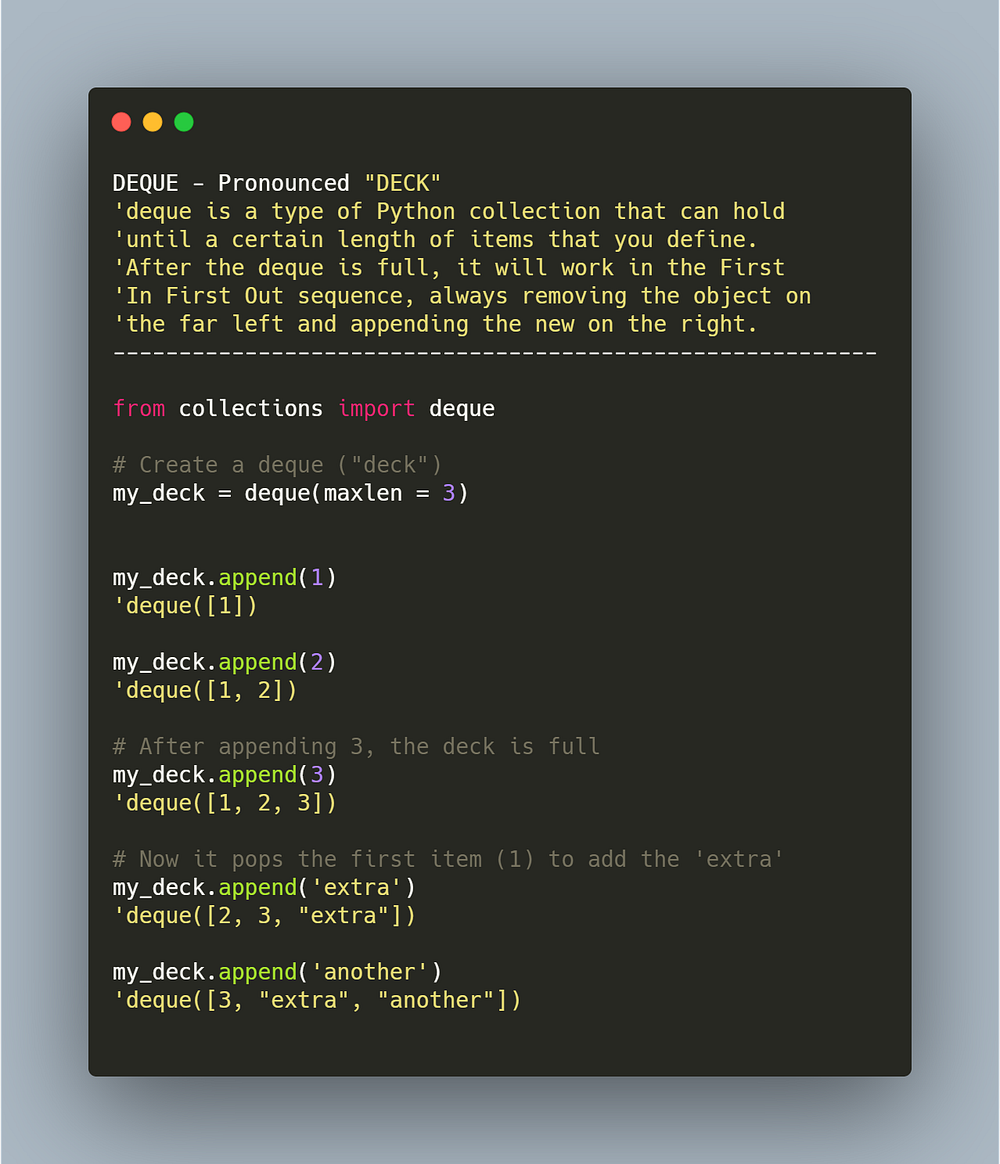
Is collections.deque Thread-Safe? How Can I Use It in Concurrent Programs?
Yes, collections.deque is thread-safe for individual append() and popleft() calls because its methods are implemented with atomic C operations. However, compound operations like checking if the deque is non-empty and then popping are not atomic and can lead to race conditions. Python’s queue.Queue and queue.LifoQueue are built on top of deque and provide full thread-safe blocking behavior with locks. For high-performance concurrency, you can use deque directly with manual locking (e.g., threading.Lock) for sequences of operations. A typical use is a producer-consumer pattern where one thread pushes data and another pops it. Deque’s O(1) operations minimize contention. For more on maximizing performance, see how deque compares to lists in benchmarks.
How Does Deque Compare to Lists in Terms of Memory and Speed?
Speed: Deque is vastly superior for operations at the left end (O(1) vs O(n)). For right-end operations, both are O(1) amortized, but deque avoids the occasional resize penalty that lists incur. In benchmarks with a sliding window of size 10,000 and 100,000 updates, deque can be over 100 times faster. Memory: Deque uses more memory per element than lists because of the overhead of block linking (approx. 64 bytes per block header). However, it doesn't overallocate like lists. For large windows with dynamic sizing, deque may be more memory-efficient overall because it doesn't keep extra capacity. For static arrays where you never pop from the front, a list is fine. For anything else, deque is the clear winner.
What Are the Limitations of deque I Should Be Aware Of?
While deque is incredibly useful, it has a few quirks:
- No slicing or direct indexing – Accessing elements by index is O(n) because it must traverse the linked structure. Use
list()conversion or thecollections.deque__getitem__method sparingly. - No built-in sort – If you need sorted order, you must copy to a list and sort.
- Limited to fixed length – While you can set a maxlen automatically discarding old elements, you cannot resize without creating a new deque.
- Not serializable as easily – Deque cannot be JSON serialized directly; you need to convert to a list.
For most sliding window and queue applications, these limitations are irrelevant. If you need random access often, consider a list with manual index management, or use a numpy array for large numeric data.