Hermes Agent: The Self-Improving AI Revolution on Your PC
Agentic AI is transforming how we work, and the open-source community has rallied behind a new champion: Hermes Agent. Developed by Nous Research, Hermes has skyrocketed to over 140,000 GitHub stars in under three months and is now the most-used agent globally on OpenRouter. Its secret? A design focused on reliability, self-improvement, and local execution. Hermes is provider- and model-agnostic, optimized for always-on operation on NVIDIA RTX PCs, RTX PRO workstations, and DGX Spark. Let’s dive into the key features that make Hermes a game-changer.
What is Hermes Agent and why has it become so popular?
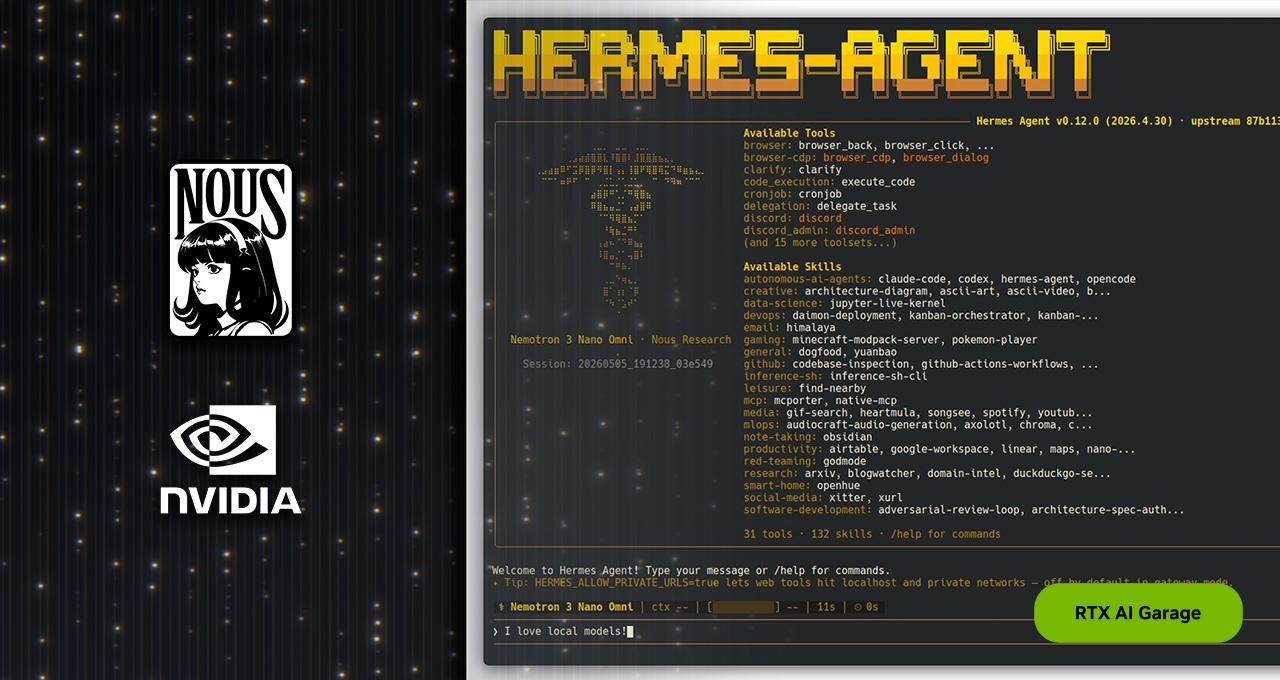
Hermes Agent is an open-source, local-first AI framework developed by Nous Research. Unlike many agents that rely on cloud APIs, Hermes runs entirely on your local machine, offering privacy, speed, and constant availability. Its popularity exploded because it delivers on two historically difficult promises: reliability and self-improvement. Within three months of release, it crossed 140,000 GitHub stars, and according to OpenRouter, it’s now the most-used agent worldwide. This rapid adoption stems from its ability to work well even with smaller local models, its integration with messaging apps and file systems, and its active orchestration layer that outperforms thin wrappers. Developers and enthusiasts flock to Hermes because it just works—without the constant debugging typical of other frameworks.
How does Hermes achieve self-improvement through self-evolving skills?
One of Hermes’ standout features is its self-evolving skills mechanism. Every time the agent encounters a complex task or receives feedback, it analyzes the approach and saves the successful strategy as a reusable skill. This means Hermes continuously adapts and refines its own capabilities over time, learning from both successes and corrections. The result is an agent that becomes more efficient and accurate with each interaction, without requiring manual updates or retraining. This self-improvement loop runs locally, so the agent gets smarter while protecting your data. For example, if you ask Hermes to automate a multi-step data processing task, it will create a skill for that workflow; next time you request something similar, it can execute the learned process faster and with fewer errors.
What are contained sub-agents and how do they improve performance?
Hermes manages complex tasks by spawning contained sub-agents—short-lived, isolated workers dedicated to specific sub-tasks. Each sub-agent receives a focused context and a limited set of tools, preventing confusion and keeping the main agent’s task organization tidy. This modular approach allows Hermes to operate with smaller context windows, which is ideal for local models that have limited memory. By breaking down a large job into smaller, independent pieces, Hermes reduces cognitive load and errors, leading to more reliable results. For instance, if you ask it to research a topic, summarize findings, and generate a report, Hermes might spawn one sub-agent for research, another for summarization, and a third for formatting—all working in parallel within isolated environments, then merging outputs seamlessly.
How does Hermes ensure reliability by design?
Nous Research curates and stress-tests every skill, tool, and plug-in that ships with Hermes. This rigorous quality control means that Hermes delivers consistent, predictable performance even with 30-billion-parameter-class local models. Unlike many agent frameworks that require constant debugging and tweaking, Hermes is designed to “just work” out of the box. The development team focuses on real-world robustness, not just theoretical capabilities. This reliability is a key reason why Hermes is trusted for tasks like file management, application integration, and 24/7 automation. Users can deploy Hermes on their local machine and rely on it for daily productivity without worrying about unexpected failures or hallucinations.

What hardware is recommended for running Hermes and why?
Hermes is optimized for local execution, so the quality of hardware directly impacts user experience. NVIDIA RTX PCs, RTX PRO workstations, and DGX Spark are the ideal platforms because they are purpose-built for accelerated AI workloads. RTX GPUs provide the parallel processing power needed for large language models, enabling Hermes to run at full speed around the clock. The DGX Spark offers even more power for demanding tasks. Running locally means no latency, no internet dependency, and full privacy. Additionally, Qwen 3.6 models, especially the 27B and 35B versions, are designed to run efficiently on these NVIDIA systems—the 35B model uses only about 20GB of memory while outperforming much larger models. This combination of hardware and optimized models makes Hermes fast, affordable, and accessible for personal and professional use.
What is Qwen 3.6 and how does it enhance local AI agents like Hermes?
Qwen 3.6 is a new series of open-weight large language models from Alibaba, designed specifically for local agentic AI. The series includes the 27B and 35B parameter models, which outperform their previous-generation 120B and 400B counterparts despite being smaller. These models achieve data-center-level intelligence while running on consumer-grade NVIDIA RTX hardware—the 35B model requires only about 20GB of memory. For Hermes users, this means they can run a highly capable agent on a single PC without sacrificing performance or accuracy. The optimized architecture of Qwen 3.6 makes it ideal for Hermes’ self-evolving skills and sub-agent orchestration, enabling seamless integration and better results. By pairing Hermes with Qwen 3.6 on NVIDIA GPUs, users get a powerful, local, and continuously improving AI assistant.
How do users benefit from running Hermes locally on NVIDIA hardware?
Running Hermes locally on NVIDIA RTX PCs or DGX Spark offers several key benefits. First, privacy: all data stays on your machine, never leaving for cloud processing. Second, speed: no network latency means real-time responses and uninterrupted task execution. Third, reliability: local operation ensures the agent works even without internet access. Fourth, cost: no recurring API fees; you pay once for the hardware and run unlimited tasks. Fifth, self-improvement: Hermes’ learning happens on-device, so your agent gets smarter the more you use it. For developers and power users, this setup means they can automate workflows, manage files, integrate with apps, and build custom skills—all with a system that respects their data and gives them full control. The combination of Hermes, Qwen 3.6, and NVIDIA hardware truly unlocks the potential of always-on, self-improving AI.