My Journey from Vim to Helix: A Comprehensive Q&A
After two decades of Vim and Neovim, I recently switched to the Helix text editor on a friend's recommendation. I've been using it for three months, and I'd like to share my experience in a Q&A format. Below, I tackle common questions about the transition, focusing on what works well, what doesn't, and how Helix compares to Vim. Jump to any question that interests you: What convinced you to try Helix? | How does Helix simplify language servers? | What makes Helix's search better? | How does the quick reference help? | How do Vim features translate? | How does Helix handle multiple cursors? | What are the main annoyances?
What convinced you to try Helix after 20 years of Vim?
What finally motivated me to give Helix a try was the struggle with language server configuration in Vim. For years, I bounced between building my own Neovim config from scratch and using pre-built distributions like LunarVim. Neither felt seamless. I wanted a working "go to definition" and "rename symbol" without constant tinkering. A friend mentioned that Helix, much like the Fish shell, works out of the box with minimal configuration. That promise of immediate productivity was irresistible. After three months, I can confirm that the built-in LSP support is a game-changer. It just works for most languages, and I spend far less time debugging configs and more time coding.

How does Helix simplify language server configuration?
Helix comes with built-in support for language servers, which means you don't need to manually install or configure them. The editor automatically detects which LSP to use based on the file type and connects to it. For example, if you open a Rust file, it'll use rust-analyzer; for TypeScript, it uses typescript-language-server. There's no plugin needed, no custom keybindings to set up. You get instant access to code actions, diagnostics, and refactoring like rename symbol across the project. This was a huge relief compared to Vim, where I had to fumble with plugins like Conquer of Completion or vim-lsp, and then spend hours tweaking mappings. With Helix, everything is integrated and—most importantly—reliable.
What makes Helix's search feature better than Vim's?
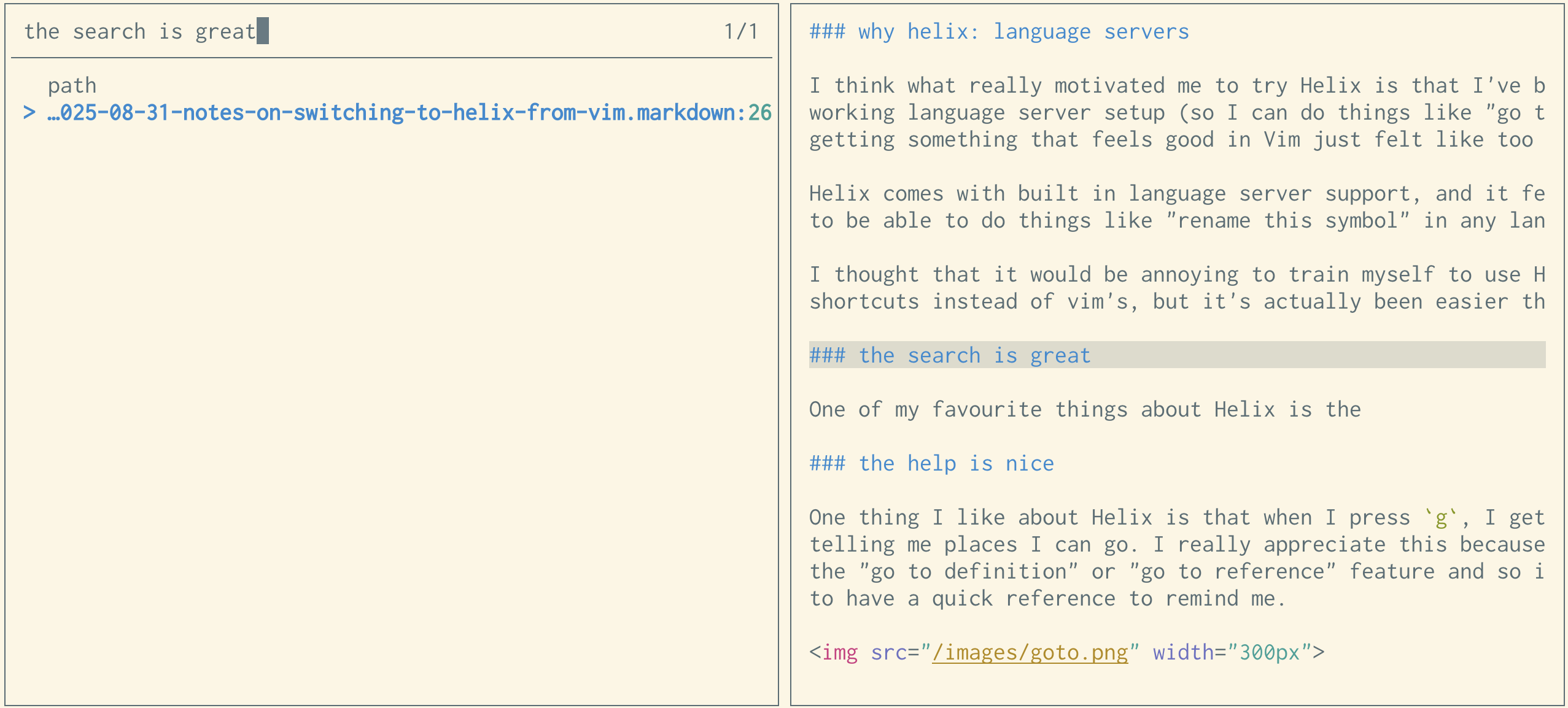
One standout feature is the search experience, especially when using a tool like ripgrep. In Helix, when you search across all files in your repository, the results pane shows the full context of each match. You see several lines around the found term, making it easy to understand the surrounding code or prose. Compare this to the typical Vim plugin (like fzf.vim) that shows only the matching line with no context. In Helix, you can scroll through the context and quickly decide which file to open. This visual context reduces guesswork and speeds up navigation. I've found it especially useful when searching through large codebases or documentation where knowing the surrounding imports or comments is critical.
How does the quick reference popup improve the editing experience?
Helix includes a clever help system that appears when you press a prefix key like g. A small popup lists all available "go to" commands such as "go to definition" (g d) and "go to reference" (g r). This is incredibly handy because I rarely use those features daily and often forget the exact key combination. Instead of pulling up a cheat sheet or digging through my memory, I just press g and the options appear right where my fingers are. It's a gentle, context-sensitive reminder. This feature also appears for other prefixes like z (for window commands). It makes the editor more approachable for both newcomers and experienced users who don't want to memorize every shortcut.
How do Vim features like marks, macros, and tabs translate to Helix?
Helix doesn't have Vim-style marks (ma, 'a). Instead, for navigating back to previous cursor positions, I use Ctrl+O (jump back) and Ctrl+I (jump forward). This works well enough for my workflow. For tabs, Helix uses a buffer-based approach rather than Neovim-style tab pages. There's a buffer switcher (<space>b) that lets you pick from a list. A setting called bufferline="multiple" provides a pseudo-tab interface with gp and gn to move between "tabs" and :bc to close one. There's also an open pull request to add real tab support, so that feature might arrive soon. Overall, the translation isn't perfect, but for most tasks there's a reasonable alternative.
How does Helix handle multiple cursors instead of macros?
Helix has macro support, but I've found that multiple cursors cover almost every case where I'd previously rely on macros. The workflow is simple: press % to select the entire file (or use visual selection), then press s to enter selection mode with a regex. For instance, to change all occurrences of a variable name, I type %s then the pattern, and Helix highlights all matches. Now I can edit them simultaneously—just type the new name and it updates everywhere at once. This feels far more intuitive and less error-prone than recording and replaying macros, especially for complex batch edits. Multiple cursors also work nicely with multi-line selections, making whole-document refactoring a breeze.
What are the main annoyances or drawbacks of using Helix?
No editor is perfect, and Helix has a few pain points. The most notable for me is text reflow. Vim's gq command reformats paragraphs beautifully, even handling lists and bullet points. Helix's :reflow doesn't handle Markdown lists well—it can mess up indentation and merge items incorrectly (there's an open GitHub issue). Another annoyance is the lack of certain Vim ex-commands I relied on. While Helix covers the basics, power users may miss the flexibility of Vim's command-line toolbox. Also, the developer community is smaller, so finding help or plugins can be harder. Overall, these issues are manageable, but they're worth knowing before you switch.